Symechaiosis
Every instruction explained with a human analogy and a practical workshop
Discover the educational book by Dr. Olivier Ami that makes machine language crystal clear and accessible to everyone, helping you build a beautiful and confident symbiosis between human and machine intelligence.


Symechaiosis
Symechaiosis is a neologism proposed by Dr. Olivier Ami. It describes a lucid and confident symbiosis between human intelligence and machine intelligence. A harmonious cohabitation to be actively designed with the thinking entities we create. Coined in 2026, the term blends syn- ("together"), mecha ("machine") and the suffix -osis, echoing symbiosis.
With the rise of increasingly powerful artificial intelligences, fear and ignorance are not options. The secret lies in dialogue and mutual understanding. To truly understand a machine, one must speak its native tongue: assembly language, which directly commands the processor.
Understanding machine language is no longer reserved for a technical elite; it is becoming an essential civic skill. It is the indispensable tool for maintaining a critical eye, a lucid control, and building a true creative collaboration with the AI of tomorrow.
“May we navigate this cognitive revolution together, with serenity, and forge hand in hand with the coming intelligences, a beautiful and confident symechaiosis.”
Why Now?
Return to Silicon
To be more performant and energy-efficient, AI and intensive computing programs are stripping away heavy abstraction layers. They are now written directly close to the processor.
Demystifying the 'Black Box'
Knowing what your compiler (C, Rust, Go) actually outputs removes the black magic. You discover that modern processors are logical, highly predictable machines.
A Civic Superpower
Understanding how the machine thinks and processes information gives you a decisive advantage in steering generative AIs and understanding their real limits.

The Book: Machine Language Made Crystal Clear
The Book's Thesis
No need for a PhD in processor architecture. A mere thirty instructions, thoroughly understood, are enough to explain 98% of what your computer actually executes every single second.
The Promise
Open the doors to a once highly exclusive club. You will transition from a developer who 'hopes' their code runs well, to an artisan who 'knows' exactly how the silicon executes it.
The Method of Analogies
To make learning instant, the book uses an unprecedented metaphorical approach: each assembly instruction is embodied by a colorful character with a precise human job. The brain grasps metaphors long before complex acronyms.
« Le cerveau saisit les métaphores avant les acronymes »
Meet the book's mascot characters

MOVInstruction
He moves data from point A to point B in the workshop without ever altering it.
Precise, tireless, and meticulous. He is the backbone of all your programs, representing over 30% of all code executed by a silicon chip.
The Author's Three Commitments
1. Rigorously Accurate
No misleading simplifications. Every statement, register, and behavior is documented, verified, and strictly compliant with Intel and AMD specifications.
2. Highly Intuitive by Example
A human analogy always precedes technical formalism. Code is displayed side-by-side: from its high-level C/C++ form to its compiled output.
3. Equipping with Reusable Tools
No rigid recipes. You learn to master the actual tools of pros (gcc, objdump, gdb, perf, Compiler Explorer) to run your own investigations.
Three tailored reading paths
Three doors to enter depending on your profile
The Full Journey
For absolute masteryFollow the book step-by-step from cover to cover. Ideal for students and developers wishing to build an intimate and unshakeable understanding of silicon.
- 15-min Quickstart (Compiler Explorer)
- 2The basics: registers, memory & stack
- 3The 30 instructions decoded one-by-one
- 4Optimization workshops & vectorization
- 5Advanced architecture (Pipelines & Caches)
What you will find in the book
A 5-Minute Quick Start
Your first program right away
No need to configure complex environments or install compilers. Thanks to the Compiler Explorer online simulator (godbolt.org), you type 3 simple lines of C and instantly watch the machine translate and arrange its tasks.
The Silicon Foundations
How the workshop organizes its tools
Discover with clear visual diagrams how the machine organizes its workspace: registers (tools active on the workbench), RAM (the large storage drawers), state flags (the control dashboard), and the call stack (the task hand-off protocol).
The Detective's Toolkit
Observing the processor in full action
Master the authentic inspection instruments used by performance experts: gcc/clang to compile, objdump to dissect, gdb to step through, perf to measure, and Compiler Explorer. You become a detective capable of solving any mystery on the silicon.
The 30 Decoded Instructions
Every command explained by its trade
The core of x86-64 assembly explored one by one. From MOV to RET, including SUB, XOR, LEA, Jcc, and complex floating-point operations. Each sheet includes: a human analogy, original C code, compiled machine code, typical pitfalls, and a 5-minute mini-workshop.
Fun Progress Checkpoints
Validate your skills without stress
Throughout your reading, enjoy short quizzes, diagrams to complete, and quick paper-and-pencil exercises to firmly anchor the logic of instructions. It's the best assurance of comprehension before moving on to the next chapter.
Under the Hood of Modern Chips
Pipelines, caches, and branch prediction
Go beyond the basics. Understand how modern processors optimize execution: pipelining (assembly line work), cache levels (L1, L2, L3 to prevent slow trips to RAM), branch prediction (anticipating the future), and an introduction to vectorization.
Cheat Sheets & Mind Maps
Your permanent development companions
The book provides highly visual cheat sheets, register lookup tables for standard system call conventions, synthetic mind maps for quick memory recall, detailed answers to all workshops, and a C-to-assembly glossary.
Who is this book for?

Mid & Senior Developers
Who write C, Rust, Go, C++, or compiled Python, and want to progress from a speculative coder to a craftsman who masters the silicon.
Computer Science Students
Who find computer architecture or compiler classes abstract. This book provides the intuitive click that brings meaning to equations.
Curious Self-Learners
Who code out of passion and suffer from 'impostor syndrome' regarding hardware. This book permanently breaks down the barrier of complexity.
Professionals in the AI Era
Eager to understand how future ultra-fast AI models will interact with hardware, keeping control and staying one step ahead.
Prerequisites Suggested
Recommended prerequisite: having written a simple loop (for/while) and manipulated a pointer or reference in any language. No prior background in electronics or assembly is required.
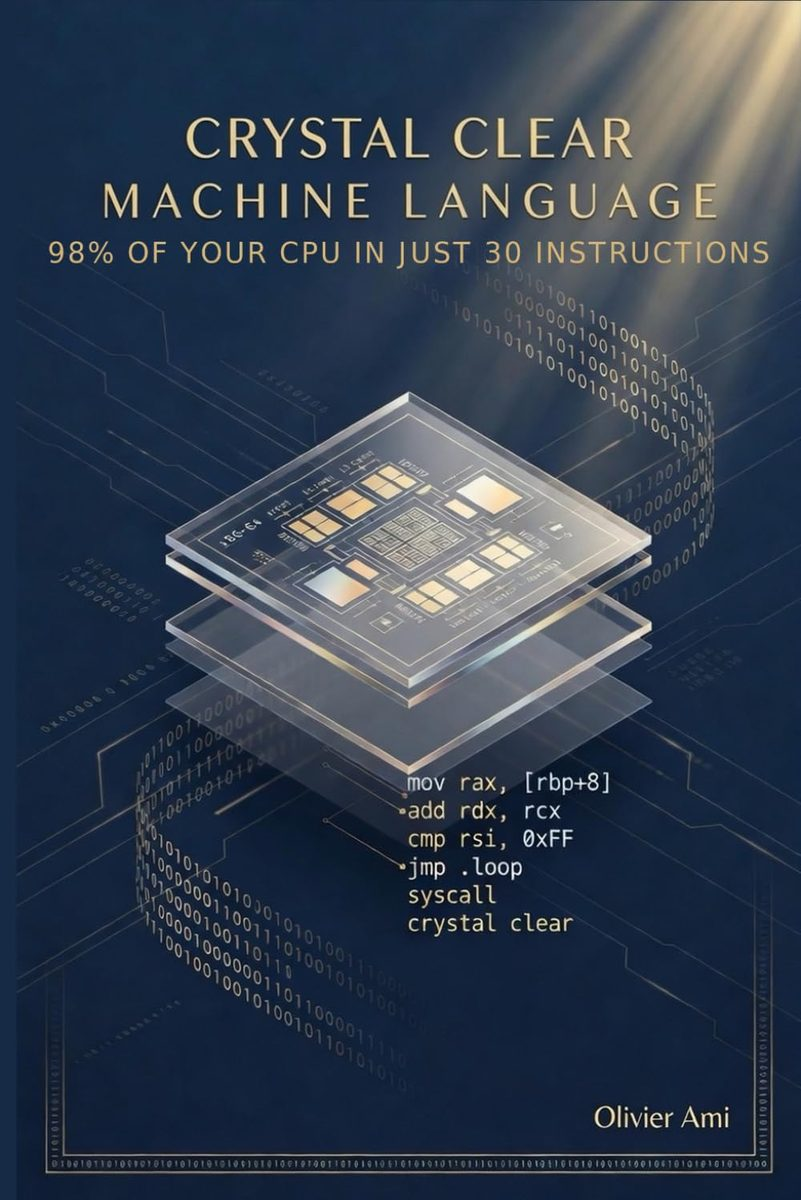
Order “Machine Language Made Crystal Clear” on Amazon
- The unique teaching method using human analogies
- Thirty essential instructions decoded step-by-step
- Interactive hands-on workshops based on Godbolt.org
- Cheat sheets, visual mind-maps, and full glossary included
Premium print edition, paperback & digital format (Kindle/ePub)
Docteur Olivier Ami
Medical Doctor, Computer Scientist & Researcher • Ramsay Santé - La Muette Clinic, Paris
Dr. Olivier Ami is both a medical doctor (obstetrician, pioneer in 3D childbirth imaging and biomechanical simulation of childbirth) and a computer scientist. Affiliated with Ramsay Santé La Muette, he devotes his double expertise to building solid bridges between life sciences, cutting-edge medicine, and computational sciences. Passionate about teaching, he designed this book to demystify the most intimate workings of computers, enabling everyone, from physicians to developers, to understand the native tongue of processors and confidently approach our shared future with AI.

Center of excellence • Alliance of cutting-edge medicine and technology

Surgeon & Computer Scientist
Frequently Asked Questions
The essentials about symechaiosis, the book and the author.
What is symechaiosis?
Who coined the word “symechaïose”?
What is the book “Machine Language Made Crystal Clear” about?
Why are 30 instructions enough to understand 98% of code?
Who is this book for?
Who is Dr. Olivier Ami?
Why learn machine language in the age of AI?
Where can I buy the book?
Have a question? Write to the author
Dr. Olivier Ami will be delighted to answer your pedagogical or scientific inquiries.